Wall Street Journal reveals behind-the-scenes story of Bab al-Mandab offensive: Houthis planned for months and exploited divisions among rivals

Euro Times – Stockholm
The lightning offensive that brought the Houthis to the heart of the Bab al-Mandab Strait was not an operation hastily assembled to exploit the Iran-U.S. war. It was the result of months of preparation, the mobilization of thousands of fighters and weapons, and the systematic exploitation of divisions within Yemen’s anti-Houthi camp, according to new details reported by the Wall Street Journal.
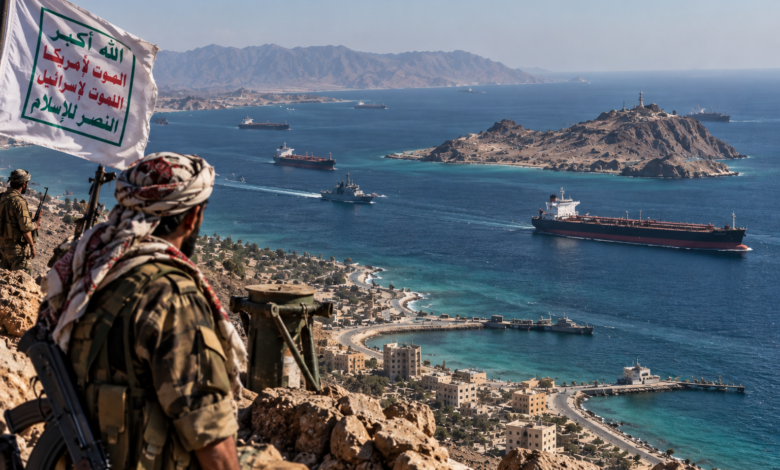
The new information helps explain the speed with which strategic positions along Yemen’s western coast collapsed before the fall of the port of Mocha and then Perim, also known as Mayyun, an island at the center of one of the world’s most important maritime corridors.
According to the Wall Street Journal report, the Houthis began moving weapons and forces toward the coast well before the offensive and intensified preparations in mid-August by deploying thousands of fighters and weapons around Mocha and threatening the defenders’ supply lines.
Intercepting rivals and sowing confusion
The newspaper says the Houthis benefited from their control over Yemeni communications systems to listen to their opponents’ calls, using that capability to spread confusion, intimidate rival forces and encourage some units to abandon their positions.
The offensive therefore relied not only on missiles, drones and manpower, but also on intelligence preparation and psychological warfare. After weeks of buildup, the Houthis seized Mocha port on Thursday and moved the following day onto Perim island in the middle of Bab al-Mandab.
One force facing eight armies
The Wall Street Journal estimates the Houthi military force at about 350,000 fighters, after years of war, expansion and the development of increasingly sophisticated missile, drone and battlefield capabilities.
Yet one of the keys to the offensive was not Houthi strength alone, but the condition of their opponents. Yemen analyst Mohammed al-Basha described the contrast as a unified Houthi movement with one command, one ideology and a clear vision facing an anti-Houthi camp made up of what he called “eight armies” and multiple leaderships.
The anti-Houthi forces include factions with different objectives and loyalties, including southern groups seeking the restoration of an independent southern state, forces linked to the former internationally recognized government and factions connected to the Islah party.
Saudi-UAE rift left an opening
The newspaper traces part of the weakness to divisions within the anti-Houthi coalition. UAE-backed forces had for years maintained a presence on Perim and in surrounding areas, but disagreements between Saudi Arabia and the United Arab Emirates over Yemen weakened that arrangement.
According to the report, tensions intensified after a December dispute over support for competing Yemeni factions, before the UAE stepped back from its role in the war. Positions that had formed an important defensive line against the Houthis consequently became more vulnerable.
An official from the Southern Transitional Council accused Saudi Arabia of mishandling the campaign, illustrating the depth of divisions within the camp that was supposed to prevent the Houthis from reaching Bab al-Mandab.
Saudi hesitation as the offensive began
The report also sheds light on Saudi calculations. After years of war in Yemen and thousands of airstrikes that failed to eliminate the Houthis, Riyadh was reluctant to be drawn back into a large-scale conflict, particularly while dealing with the consequences of the war with Iran and growing pressure on its oil infrastructure.
Anti-Houthi Yemeni officials told the newspaper that they requested Saudi airstrikes to support their defenses, but Riyadh did not respond with the speed or scale they wanted, helping the Houthis advance.
Saudi Arabia had maintained a de facto truce with the group for years. Saudi energy officials told the newspaper in April that the kingdom had received assurances from the Houthis that they would not attack Saudi Arabia or its ships. That understanding collapsed as the regional war widened.
Iran and the wider war
The Journal’s account intersects with earlier Reuters reporting on direct Iranian support for the offensive.
Reuters reported, citing Yemeni, Iranian and regional sources, that Iran’s Revolutionary Guards provided weapons and military advice and that Iranian commanders helped guide the western-coast campaign as part of an effort to open another front against Saudi Arabia and the United States during the Iran-U.S. war.
Saudi Arabia between Hormuz and Bab al-Mandab
The strategic consequences extend far beyond Yemen. Perim sits in the Bab al-Mandab Strait, about 18 miles wide at its narrowest point, forming the gateway from the Red Sea toward the Suez Canal.
The route has become even more important for Saudi Arabia as the war with Iran has restricted shipping through the Strait of Hormuz. Yet Riyadh’s western alternative is now itself exposed to Houthi pressure.
The problem has been compounded by drone attacks on the Saudi East-West oil pipeline, which carries crude from the kingdom’s east to Yanbu on the Red Sea to bypass Hormuz. Saudi Arabia therefore faces three interconnected pressure points: Hormuz to the east, the East-West pipeline inside the kingdom, and Bab al-Mandab to the west.
Recent Reuters data showed commercial traffic through Bab al-Mandab falling on Monday to 21 vessels from 28 the previous day, while only four commodity vessels crossed Hormuz that day, compared with roughly 125 large commercial vessels a day before the war.
Retaking the island would not end the threat
The challenge for Saudi Arabia and international powers would not necessarily disappear even if the Houthis were pushed off Perim or away from parts of the coast. Their missile and drone arsenal allows them to threaten Red Sea shipping from considerable distances.
The strategic parallel with Iran in Hormuz is clear: a maritime chokepoint does not need to be completely closed to become an instrument of pressure. The ability to threaten ships, raise insurance and freight costs and force companies to reroute can be enough.
After years in which the Houthis were viewed primarily as a party to Yemen’s civil war, their gains around Bab al-Mandab have placed them directly inside the energy and security equation of the Iran-U.S. war.
The question confronting Riyadh and Washington is no longer simply how to stop their advance on land, but how to secure a global maritime corridor that the group can continue to threaten even if the territorial map changes.