
US Indicts Three Iran-Backed Operatives Over 18 European Attacks and Plot Against RAF Fairford

US prosecutors charge three Iran-backed operatives over 18 attacks in Europe and a plot against RAF Fairford, revealing video coordination and coded jail messages.
EURO TIMES / Ali Aljabiri
The US Department of Justice has disclosed details of an alleged Iran-backed network linked to the Islamic Revolutionary Guard Corps (IRGC) and Iraq’s Kata’ib Hizballah. According to an eight-count superseding indictment unveiled on November 10, 2026, three operatives were involved in nearly 20 attacks and attempted attacks across Europe and the United States, culminating in a September plot against RAF Fairford, a British air base hosting US military aircraft and personnel.
Three defendants and an international network
The defendants are Mohammad Baqer Saad Dawood al-Saadi, 32, a dual Iranian-Iraqi national; Mohsen Mohajeri, 48, an Iranian national; and Mohammad Ali al-Hassani, 35, an Iraqi national. US prosecutors describe al-Saadi as a longtime operative of the IRGC and Kata’ib Hizballah, Mohajeri as an IRGC operative coordinating the European campaign, and al-Hassani as an organizer who drew on associates in the United Kingdom. The indictment portrays a network able to identify targets, coordinate operatives across borders, and produce videos claiming responsibility for attacks.
The group behind the name Harakat Ashab al-Yamin al-Islamiya
The attacks were claimed under the name Harakat Ashab al-Yamin al-Islamiya (HAYI), which the Justice Department describes as a front for Kata’ib Hizballah and other US-designated foreign terrorist organizations. HAYI claimed 18 attacks in Europe during spring 2026. Seven occurred in the United Kingdom, more than in any other European country. The attacks included arson, explosive devices and a near-fatal stabbing of two Jewish men in London, one of whom holds both British and American citizenship.
A meeting in Iraq, with London on the screen
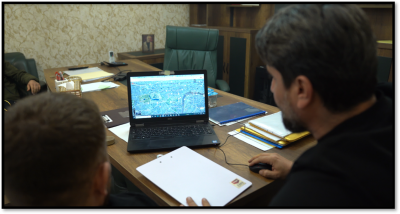
US investigators describe an April 6 meeting in Iraq between Mohajeri and al-Hassani, with a map of London displayed on a computer. A recording cited by prosecutors captures the participants discussing the British capital as a focus for future attacks. About a week later, HAYI began claiming responsibility for six attacks in and around London. A still from the meeting published by the Justice Department shows al-Hassani on the left and Mohajeri on the right.
Attacks directed over live video
On or around April 17, prosecutors say al-Saadi, al-Hassani and Mohajeri monitored an attack in Europe in real time through a FaceTime call projected onto a large screen displaying the HAYI emblem. Al-Hassani gave instructions to the person carrying out the attack, while al-Saadi filmed the live operation and Mohajeri recorded the coordinators in the room.
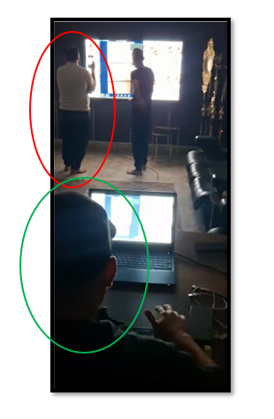
On April 18, the indictment says al-Hassani joined another video call involving an attack on a synagogue in London. The attacker ignited an improvised explosive device and threw it towards a building. Prosecutors cite these recordings as evidence of operational control exercised remotely by members of the network.
Weapons, a US map and a list of officials
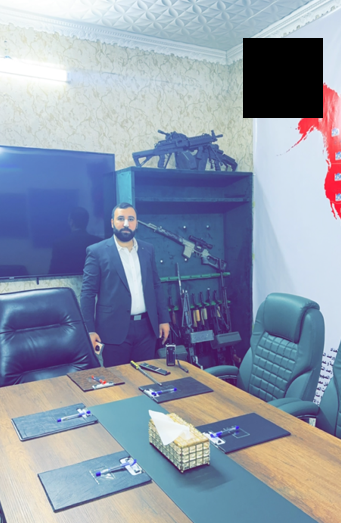
The Justice Department also released a photograph of al-Saadi taken around February 2024. It shows him in a conference room in front of machine guns, with a map of the United States and a redacted list of current and former American officials described in the document as targets. Investigators separately linked al-Saadi to an alleged attempt to bomb a synagogue in Manhattan during March and April 2026. He was arrested abroad in early May and subsequently transferred to US federal custody.
RAF Fairford: a new target in September
The indictment’s latest chapter concerns RAF Fairford in Gloucestershire, England, where US aircraft and personnel were stationed. Prosecutors say al-Hassani and Mohajeri coordinated the plot from Iran using contacts in Britain. Despite being held in New York on terrorism charges, al-Saadi allegedly attempted to communicate with the other two through coded messages passed via relatives and intermediaries.
On August 22, al-Hassani allegedly paid a contact to conduct reconnaissance around the air base and record its roads and approaches. Video from the location was then passed to him. Further preparations involved vehicles, materials and commercial logos intended to make the vehicles resemble those operated by civilian service companies.
Three white vans and the security cordon
On September 26, three white vans moved towards RAF Fairford. Some carried fuel drums, according to the US authorities. Al-Hassani remained in contact with the drivers and guided their movements. A security cordon prevented at least two vehicles from reaching their intended route around the base. In the early hours of September 27, British authorities located all three vans, which displayed the fictitious business markings, and detained their occupants. The alleged operation was disrupted before an explosion at the base.
Coded messages from a New York jail
Investigators say al-Saadi made calls to his mother and sister in Iraq during June, July and September, using indirect references and alternative names for associates. Mohajeri was referred to as “Abbas”, “Abu Daniel” and “Mr Abbas”, while the term “work” appeared in conversations prosecutors linked to the network’s activities. In one call, al-Saadi asked whether their “old work” had been cancelled or merely paused; his sister replied that it had not been cancelled.
On September 24, two days before the vans approached the air base, al-Saadi allegedly asked about al-Hassani using the name “Ali” and discussed transferring money to support the operation. US prosecutors present the timing of those calls as part of the evidence linking the detained defendant to the Fairford preparations.
Eight charges and possible life sentences
The superseding indictment contains eight counts covering conspiracies to provide material support to designated foreign terrorist organizations and terrorist acts, attempted transnational terrorism, explosives-related offences, property destruction and terrorism financing. The charges differ among the defendants. Some carry maximum sentences of 15 or 20 years; two can carry life imprisonment, and another includes a five-year mandatory minimum.
The wider investigation
US officials said the case illustrates how a network allegedly connected to Iranian-backed organizations operated across multiple countries, targeting Jewish communities and eventually a military installation hosting American personnel. The investigation involves the FBI’s Joint Terrorism Task Force, the New York Police Department and British authorities. The case also highlights a four-month period without further attacks attributed to the group after al-Saadi’s arrest, followed by the September Fairford plot.
Sources: US Department of Justice, November 10, 2026; US Attorney’s Office, Southern District of New York.