Left Party doubles its vote in Rinkeby, Ronna and Rosengård – have immigrant suburbs reshaped Sweden’s election map?

Euro Times – Stockholm
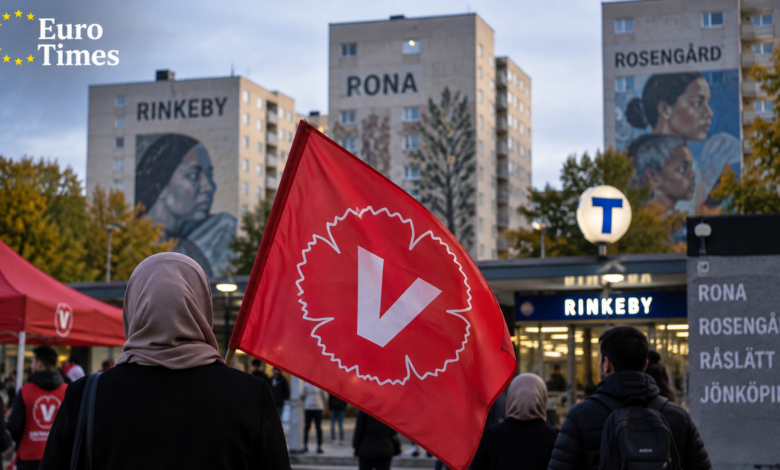
Preliminary results from Sweden’s 2026 election reveal a striking shift in several suburbs and areas classified by police as vulnerable, where the Left Party (V) made major gains. Its share of the vote doubled in parts of Rinkeby in Stockholm, Ronna in Södertälje and Rosengård in Malmö, while the increase was even larger elsewhere.
The results are significant beyond the party’s national gain because they reveal a clear geographical pattern in some areas with large immigrant populations, raising the question of whether voter mobilisation in these suburbs helped redraw part of the electoral map on the left.
Threefold support in Råslätt and doubled backing in major suburbs
According to an analysis by SVT based on preliminary results, support for the Left Party in Råslätt, south of Jönköping, rose to around three times its level in the 2022 election.
In parts of Rinkeby in Stockholm, Ronna in Södertälje and Rosengård in Malmö, the party’s support doubled compared with the previous election. SVT also identified a similar pattern in other areas classified as vulnerable.
Nationally, the preliminary results indicate that V increased its vote share by around 1.5 percentage points, making the local surges in these areas far larger than the party’s overall national improvement.
A political counterweight to SD
Political science professor Jenny Madestam says the Left Party succeeded in presenting itself in these areas as a clear political counterweight to the Sweden Democrats (SD), while actively mobilising voters in districts with large immigrant populations.
According to her analysis for SVT, part of the increase may also have come from voters who previously backed the Social Democrats but regarded the Left Party as a clearer alternative on some issues.
Did voter mobilisation in the suburbs matter?
Before the election, several campaigns sought to increase turnout in districts where electoral participation has historically been low. SVT also reported on mobilisation efforts in a number of mosques and local communities encouraging residents to vote.
Researchers had suggested before election day that higher participation in areas with large immigrant populations could benefit parties on the left. The current results, however, do not establish that mosque activity or any single campaign directly caused V’s gains. What the preliminary figures do show is a substantial increase in support for the party in several of these districts.
V’s gains create a new complication for the opposition
The paradox is that the Left Party’s electoral success may simultaneously make negotiations over Sweden’s next government more difficult.
The Centre Party (C) does not want V to enter the next government, while the Left Party wants a place in negotiations and expects its increased electoral weight to be reflected in any future political agreement. The additional votes therefore strengthen V inside the opposition bloc while also making a four-party governing formula more complicated.
Results remain preliminary
The local figures should still be treated as preliminary until the final count is completed. Nevertheless, the scale of the gains in areas such as Rinkeby, Ronna, Rosengård and Råslätt is already large enough to make them one of the most notable geographical patterns of the 2026 election.
The question parties will have to examine after the count is complete is not only why the Left Party advanced, but whether suburbs where low turnout has long been a problem are becoming a more politically mobilised electoral force capable of influencing the national balance of power.