Inside the Tehran Talks: Hormuz, the Houthis, Israel and the Gulf States in a New Regional Security Initiative

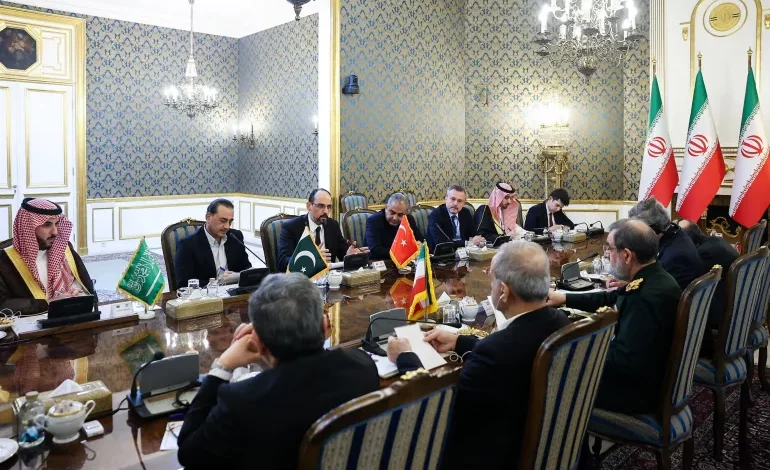
An in-depth report on the Saudi-Turkish-Pakistani mission to Tehran, the reported Hormuz bargain, Houthi attacks, Israel’s position and the role of other Gulf states.
Euro Times / Political Editor
Senior officials from Saudi Arabia, Turkey and Pakistan held high-level talks in Tehran as regional powers sought to avert another US-Iranian war. Reports of the discussions point to proposals covering the Strait of Hormuz, the US blockade, frozen Iranian funds, Houthi attacks, nuclear restrictions and a regional non-aggression framework, while Israel and other Gulf states remain crucial to the outcome.
A security mission at a critical moment
Saudi Defence Minister Prince Khalid bin Salman, Pakistan’s army chief Field Marshal Asim Munir and Turkish intelligence chief Ibrahim Kalın travelled to Tehran on 26 October 2026 for talks with Iran’s leadership. President Masoud Pezeshkian and senior Iranian security officials took part. The visit brought together senior representatives of the three states associated with the Mecca mutual defence pact, giving the initiative a pronounced security dimension as fears grew of renewed US-Israeli military operations against Iran.
Inside the talks: a regional non-aggression framework
According to a senior Pakistani security official cited by Reuters, the discussions covered a possible regional non-aggression network, Gulf security, Houthi attacks on Saudi Arabia and the disruption of shipping through the Strait of Hormuz. Another Pakistani official said Munir was advancing a diplomatic proposal with US President Donald Trump’s approval to pursue mediation. Saudi Arabia, Turkey, Pakistan and Qatar were discussed as possible guarantors of a future arrangement. The reported American endorsement of diplomatic engagement does not amount to confirmation that Washington accepted every element of the proposal. No binding text or enforcement mechanism was announced.
Hormuz, the US blockade and frozen Iranian funds
The Financial Times reported a phased proposal under which Iran would reopen the Strait of Hormuz in return for the lifting of the US blockade on Iranian ports and renewed access to frozen Iranian funds. The measures would create space for broader negotiations. The sequence of concessions remains central: Tehran wants sanctions and restrictions on its oil exports eased before nuclear concessions, while Washington seeks limits on enrichment. Iran’s ambassador to Pakistan had previously told the Associated Press that Tehran had offered to reopen the strait if the US ended its blockade, an offer he said Washington rejected.
The nuclear stockpile remains unresolved
A broader settlement would have to address Iran’s uranium enriched to 60 percent. The International Atomic Energy Agency estimated the stockpile at approximately 440.9 kilograms before the strikes. The precise whereabouts and condition of the full inventory following military operations remain unresolved. Reports have raised the prospect of transferring highly enriched material abroad, but Iranian officials have resisted placing nuclear concessions ahead of guarantees on hostilities, sanctions and oil exports. A limited maritime arrangement would therefore not, by itself, constitute a comprehensive nuclear agreement.
The Houthis and Saudi Arabia’s immediate security concerns
Yemen was a significant part of the Tehran discussions, according to the Pakistani account reported by Reuters. The visit coincided with Houthi claims of attacks on Saudi oil infrastructure and Riyadh airport, as well as continued Saudi operations against Houthi positions in Yemen. Some claims of strikes had not been independently confirmed when reported. Saudi Arabia faces pressure on two strategic export corridors: Hormuz to the east and the Red Sea and Bab al-Mandab to the west. A durable de-escalation arrangement would need to address attacks on Saudi territory and the maritime routes serving the kingdom. No publicly announced Iranian undertaking to halt Houthi operations emerged from the meeting, and the Houthis themselves were not identified as signatories to any proposed agreement. Tehran maintains that the group makes its own decisions, while Washington and Riyadh accuse Iran of supporting it.
A reported Israeli option in the Saudi calculus
Radio Free Europe/Radio Liberty quoted a Pakistani security official discussing the possibility of using closer Saudi-Israeli security cooperation as leverage if Iran failed to help restrain the Houthis. The report described a possible negotiating pressure point, not a publicly adopted Saudi decision to normalise relations with Israel or request Israeli military assistance. Nor has the account established that such a proposal was formally presented during the Tehran meeting. Its significance lies in the way the Yemen conflict intersects with wider regional security alignments.
Israel: military pressure and political calculations
Israel remains a major factor in the prospects for a US-Iranian accommodation. Prime Minister Benjamin Netanyahu has continued to press a hard line towards Tehran, while Israeli security concerns extend beyond uranium enrichment to Iran’s missiles and regional armed partners. Israeli and US media have reported disagreements over the timing of possible military action, although Netanyahu’s office has disputed some accounts. No Israeli endorsement of the Tehran initiative has been announced. An interim agreement on Hormuz and sanctions would leave open the question of whether Israeli-Iranian confrontation could be contained without a wider security settlement.
Qatar, Oman and the other Gulf states
Qatari mediators met Iranian officials on 25 October, one day before the Saudi-Turkish-Pakistani visit, and Doha was named among the possible guarantors of a settlement. Oman has advocated regional non-aggression arrangements and has a direct interest in the safety of navigation through Hormuz. The United Arab Emirates likewise has substantial strategic and commercial interests in secure shipping, ports and energy exports; no specific Emirati endorsement of the formula discussed in Tehran has been announced. Kuwait and Bahrain share the broader Gulf security concerns but were not represented in the visiting delegation. The talks were not conducted under a publicly announced mandate from all six members of the Gulf Cooperation Council, leaving the question of wider Gulf participation central to any eventual regional agreement.
The Mecca pact and Egypt’s defence role
Saudi Arabia, Turkey and Pakistan signed the Mecca mutual defence pact in August 2026. The arrangement envisages collective responses to armed attacks, alongside intelligence cooperation and defence coordination. Pakistan has ratified the pact, while Turkey’s parliamentary ratification process was still under way at the time of the Tehran visit. Separate discussions have considered measures to strengthen Saudi defences. Egypt’s parliament also approved defensive support for Saudi Arabia amid Houthi attacks. These developments show that regional governments are pursuing diplomacy while maintaining military contingency planning. Egypt’s stake is heightened by the importance of Red Sea security to traffic through the Suez Canal.
Threats to Gulf infrastructure
Reuters also reported statements from Iranian security officials about contingency plans to target undersea communications cables in the Gulf in the event of renewed US-Israeli strikes. There was no announcement that such an operation had been authorised or carried out. The reported plans nevertheless illustrate how a broader conflict could threaten communications networks alongside energy facilities, ports and shipping routes, exposing economies across the region to disruption.
A diplomatic opening, not a completed settlement
The Tehran visit brought the possibility of a regional non-aggression framework into more explicit discussion and linked the Hormuz crisis to the war in Yemen, economic restrictions on Iran and potential security guarantees. Major obstacles remain: the order of sanctions relief and maritime concessions, the unresolved nuclear inventory, verification of any non-aggression commitments, Houthi conduct and Israel’s position. The meeting produced continued consultations rather than a final agreement. Whether these proposals develop into enforceable arrangements will depend on decisions in Washington and Tehran and on the willingness of regional actors to participate in a wider security framework.
شاهد أيضًا
رابط الفيديو على يوتيوب: انقر هنا (https://www.youtube.com/watch?v=QXCQW2YXjgM)