Tehran’s four goals in Hormuz: how ISW reads Iran’s war on tankers and the mine dispute

The Institute for the Study of War sets out four Iranian aims in the Strait of Hormuz, as tanker attacks mount and the US and Iran clash over mines.
Euro Times / Stockholm – More than seven months into the US-Israeli war on Iran, the Strait of Hormuz has become more than a contested oil route: it is now the clearest test of what Tehran wants out of the conflict. That is the conclusion of the latest daily Iran Update from the Institute for the Study of War (ISW) and the American Enterprise Institute’s Critical Threats Project, which tracks a rapid escalation of Iranian attacks on shipping and a mine war marked by contradictory claims.
Four Iranian objectives
According to the analysts, Iran’s military campaign is aimed at:
- Winning international recognition of its control over the Strait of Hormuz.
- Eroding Washington’s ability and willingness to keep fighting.
- Restoring deterrence against the United States and its partners in the region.
- Driving a wedge between the US and Israel on one side and the Arab states on the other.
In this reading, the attacks on ships are not meant to shut the strait completely but to impose Iranian “rules of passage”. That fits a statement by Yahya Rahim Safavi, military adviser to the Supreme Leader, that Iran’s strategy is to manage and restrict traffic rather than close the waterway.
Tankers on fire and “unauthorised routes”
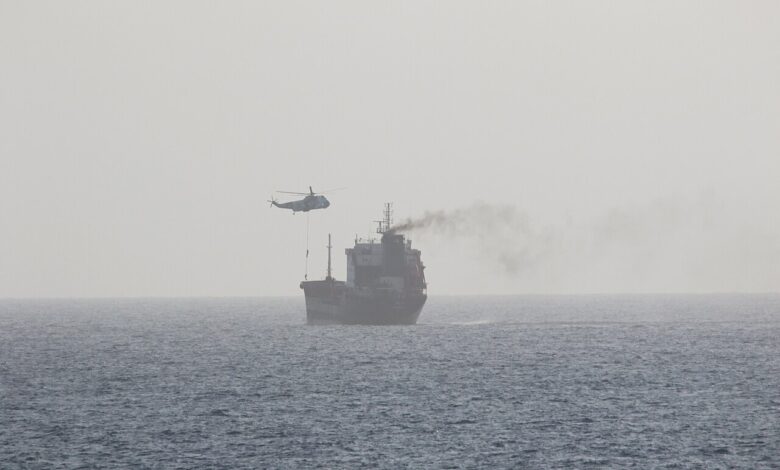
Iran continues to target merchant vessels using what it calls unauthorised routes. The UK Maritime Trade Operations centre (UKMTO) reported that unidentified projectiles struck two departing tankers on 10 and 11 October, setting one ablaze and damaging the other.
Mohsen Rezaei, secretary of Iran’s Supreme National Security Council, claimed that Iranian forces hit five or six small boats every night that ferry oil to larger tankers through Omani waters. The IRGC Navy has also said it will treat any ship that switches off its automatic identification system (AIS) as hostile.
The developments follow what Al Jazeera described as the most violent week of the war, with at least 12 vessels attacked in the week to 5 October, including one off Qatar’s northern coast. Kpler data cited by CNBC put oil exports through the strait at around 8.5 million barrels a day, roughly 40% below pre-war levels.
The mine war: two irreconcilable accounts
The report highlights a stark contradiction. On 10 October the IRGC Navy said an “outlaw” supertanker had hit a mine on an unauthorised route; a day later it said three tankers had struck mines and caught fire since then. Yet US President Donald Trump announced on 25 August that the US Navy had cleared all mines from the strait. The ISW analysts note the discrepancy without resolving it.
America’s counter-blockade
Washington, meanwhile, is maintaining its naval blockade of Iranian ports. US Central Command said a US fighter jet struck the stern of the cargo ship Ocean Molica after its crew ignored warnings and tried to run the blockade. According to figures reported by Al Jazeera, since the blockade was reimposed in mid-July US forces have disabled four merchant ships, turned back 135 and destroyed ten Iran-linked tankers.
On the diplomatic track, the report sees no meaningful progress. Tehran’s conditions for reopening the strait are a return to the memorandum of understanding that collapsed after it was signed in June, and US backing for an Iranian-Omani agreement on coordinated shipping lanes.
The second front: Bab al-Mandab
The report does not treat Hormuz in isolation from Yemen. Houthi military spokesman Yahya Saree has warned against the use of Saudi airports and airspace and vowed to keep attacking until the group’s goals are met. ISW lists those goals as ending Saudi support for the government forces’ counter-offensive, lifting Saudi restrictions on Houthi-held ports and airports, securing war reparations and public-sector salaries, and gaining control of Yemen’s oil and gas. On 10 October, Trump said he was considering US strikes on the Houthis in response to their attacks on Saudi Arabia.
Taken together, Iran and its allies appear to be squeezing the region’s oil lifeline from both ends – Hormuz in the east and Bab al-Mandab in the west. The question now being asked in Washington and Gulf capitals is which end gives way first.